The $440 Billion Opportunity in Activewear — And Why the Smartest Brands Are Sourcing It from Pakistan
The global activewear market is worth $440 billion and growing at 9% a year. Everyone wants a piece of it. But while most brands are fighting over the same overcrowded factories in China and Vietnam, a quietly extraordinary manufacturing cluster in Pakistan is producing world-class activewear at prices that make the numbers work — with MOQs that do not require you to remortgage your house. Here is everything you need to know.
Let us start with a number that should make every
apparel entrepreneur sit up straight.
$440 billion.
That is the current size of the global activewear
market in 2025, according to Grand View Research.
And it is not slowing down. The market is projected
to reach $919 billion by 2033 — growing at 9% per
year, consistently, through economic cycles that
have been unkind to most other retail categories.
To put that in perspective: the global activewear
market is now larger than the GDP of most countries
on earth. It is larger than the entire economy of
Austria, the United Arab Emirates, or South Africa.
And it is still growing.
Here is the other number worth knowing.
North America accounts for 38% of that market.
The US activewear market alone was valued at
US $135 billion in 2024. American consumers are
buying yoga pants, compression tights, sublimation
jerseys, and gym hoodies at a rate that would
suggest they spend approximately six hours a day
exercising — which, if you have seen American gym
membership statistics versus actual gym attendance,
is entertainingly optimistic. But the purchasing
behaviour is real even if the workout schedules
are aspirational.
The point is this. If you are an activewear brand,
a sports uniform supplier, a private label importer,
or an Amazon seller building a performance apparel
range — you are operating in one of the fastest-growing
consumer markets on the planet.
Now let us talk about where you are going to make it.
And why the answer might not be where you think.
THE CHINA PROBLEM THAT NOBODY IS TALKING ABOUT
LOUDLY ENOUGH
For the past two decades, the default answer to
"where do I manufacture activewear?" was China.
Massive factory infrastructure. Competitive pricing.
Established sublimation printing capabilities.
Fabric mills and garment factories within the same
industrial cluster.
Then several things happened simultaneously.
Chinese labour costs rose substantially over the
past fifteen years — the manufacturing wage advantage
that made China irresistible in 2005 has narrowed
considerably. The minimum wage in manufacturing
provinces has increased by over 200% since 2010.
Then came the tariffs. The US-China trade war that
began in 2018 introduced significant additional
costs for American importers sourcing from Chinese
factories. In 2025, tariffs on Chinese textile and
apparel exports to the United States sit at 34%
or higher — a number that turns a competitive
factory price into a significantly less competitive
landed cost.
Then came what sourcing professionals call the
"China Plus One" strategy — the widespread realisation
among brands and retailers that over-reliance on a
single country for manufacturing creates catastrophic
supply chain vulnerability. COVID-19 demonstrated
this in spectacular fashion when factories shut,
shipping routes collapsed, and brands discovered
that their entire supply chain ran through one
country they had absolutely no control over.
The result is a global search for alternative
manufacturing destinations that can deliver
the quality, capability, and price competitiveness
that China used to offer — without the tariff
exposure, the supply chain concentration risk,
or the increasingly complicated geopolitics.
Vietnam has absorbed a large share of this
manufacturing migration. So has Bangladesh.
Indonesia and Cambodia have attracted attention.
But there is a country that most Western buyers
have either overlooked entirely or written off
based on outdated assumptions — that is quietly
proving to be one of the most compelling
activewear sourcing destinations in the world.
WHY PAKISTAN IS HAVING ITS MOMENT IN ACTIVEWEAR
Pakistan's textile and apparel sector is the
backbone of the national economy. It accounts
for approximately 60% of total export earnings
— and those export earnings have been growing.
Pakistan's total textile and apparel exports
reached US $17.88 billion in fiscal year 2024-25,
up 7.39% from the previous year.
But here is the part that most buyers do not
know — and that the Pakistani textile industry
has not done a particularly good job of
communicating to international markets.
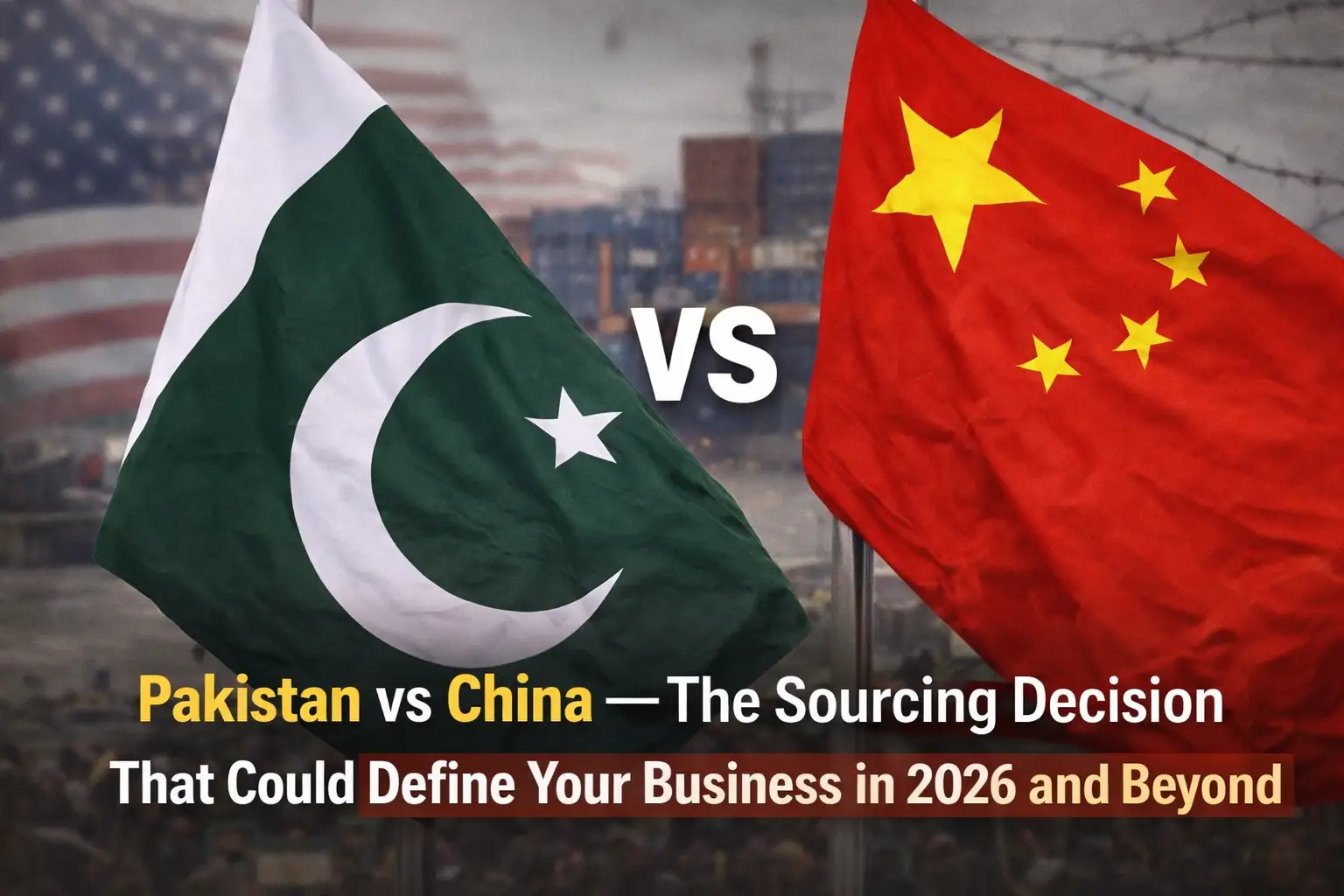
Pakistan secured a 19% US tariff rate in 2025 —
the lowest in South Asia. For context: China
faces 34% or more. Vietnam faces 46%. Bangladesh
faces 37%. Sri Lanka faces 44%.
Read those numbers again slowly.
A buyer importing activewear from China into
the United States faces a 34% tariff. The same
buyer importing equivalent quality from Pakistan
faces 19%. On a $100,000 order, that is a $15,000
difference — before you account for the fact that
Pakistani factory prices are already competitive
with or below Chinese equivalents for comparable
specifications.
This is not a marginal advantage. For brands
building their cost models in 2025 and beyond,
it is a structural competitive advantage that
changes the economics of activewear importing
from Pakistan in a fundamental way.
And the timing of this tariff advantage coincides
with something else happening in Pakistan's
textile sector — a significant upgrade in
manufacturing capability, particularly in the
performance activewear category that international
buyers care most about.
WHAT PAKISTAN ACTUALLY PRODUCES — AND HOW GOOD IT IS
Let us dispense with the outdated perception first.
Yes, Pakistan has historically been known primarily
for cotton basics — t-shirts, hosiery, denim. The
same categories that Bangladesh, India, and Vietnam
produce competitively. In those categories, Pakistan
is solid but not necessarily the most compelling
option for performance activewear buyers.
But the manufacturers in and around Sialkot —
Pakistan's extraordinary manufacturing cluster
in Punjab — have developed capabilities in
performance activewear that most international
buyers have not yet discovered.
Here is what the factories in this region
actually produce — and produce well:
SUBLIMATION JERSEYS AND TEAM UNIFORMS
Sublimation printing is the technique used to
produce the full-colour, all-over graphic jerseys
worn by football clubs, basketball teams, cycling
squads, and esports organisations worldwide.
The design is heat-pressed into the polyester
fabric ra
Ready to Start Sourcing?
Our team is ready to help you find the right manufacturer in Sialkot.
Get a Free Quote