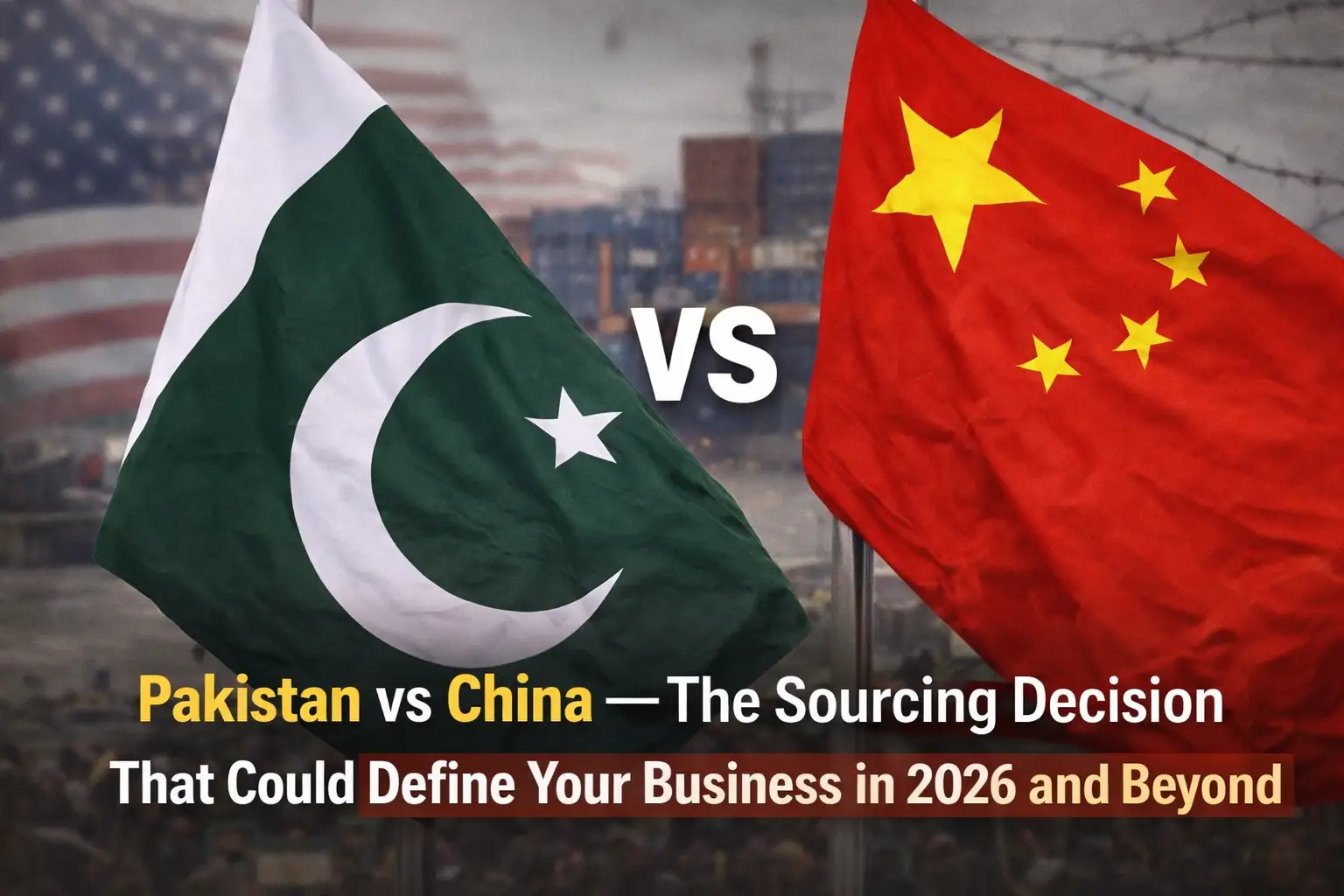
Pakistan vs China — The Sourcing Decision That Could Define Your Business in 2026 and Beyond
US tariffs on Chinese goods hit 145% in April 2025. The Supreme Court struck down the legal basis for those tariffs in February 2026 — and immediately the US launched fresh Section 301 investigations that could restore them. In the middle of all this chaos, Pakistan quietly secured a 19% US tariff rate — the lowest in South Asia. This is the honest, data-driven comparison every international buyer needs to read before placing their next sourcing order.
In April 2025, the United States imposed tariffs
on Chinese goods that briefly touched 145%.
One hundred and forty-five percent.
To put that in context — if you were importing
a container of goods from China worth $100,000,
you were handing the US government an additional
$145,000 before those goods cleared customs.
The container that used to cost you $100,000
was suddenly costing you $245,000. No change
in product quality. No change in the factory.
Just a number on a policy document in Washington
that restructured the entire economics of your
supply chain overnight.
US imports from China fell by roughly half
in the months that followed — to levels not
seen since the 2008 global financial crisis,
according to the Peterson Institute for
International Economics.
Then in February 2026 the US Supreme Court
struck down those tariffs — ruling that the
President had overstepped his authority in
imposing them under the International Emergency
Economic Powers Act.
Problem solved? Absolutely not.
Within weeks of the Supreme Court ruling,
the US Trade Representative launched new
Section 301 investigations into Chinese
manufacturing practices — specifically
targeting structural excess capacity and
forced labour. These investigations, if
they conclude that action is required,
give the President authority to impose
new tariffs on Chinese goods through a
different legal pathway. Hearings are
scheduled through April and May 2026.
New tariffs are considered a likely outcome.
The trade war between the United States
and China is not over. It has not even
reached a stable ceasefire. It is in
active legal and diplomatic flux —
with both sides launching new
investigations, retaliatory measures,
and export controls almost monthly.
For any buyer whose supply chain runs
through China, this is not an abstract
geopolitical story. It is a direct
financial risk that lands on your
landed cost calculation every time
a new tariff is announced, extended,
reduced, or restored.
This article is the honest,
data-driven comparison you need
to make an informed decision
about where to source in 2026
and beyond.
THE GEOPOLITICAL PICTURE THAT EVERY
BUYER IS WATCHING BUT NOBODY IS
SAYING OUT LOUD
The tariff war is the visible part
of a much deeper structural conflict
between the United States and China
that has been building for a decade
and shows no sign of resolution.
Here is what the current situation
actually looks like:
China has launched export controls
on rare earth minerals — materials
critical to US electronics, defence,
and clean energy manufacturing.
These controls are a direct
geopolitical weapon, and China
has demonstrated a willingness
to use them.
The US is actively investigating
whether to revoke China's Permanent
Normal Trade Relations status —
a move that would fundamentally
restructure all US-China trade
under far higher tariff rates
permanently.
Taiwan Strait tensions remain
elevated. A military conflict
involving Taiwan — however
unlikely in the short term —
would instantly sever supply
chains that run through Taiwan,
China, and the broader East Asian
manufacturing corridor.
The US has imposed Section 301
fees on deliveries by Chinese
ships entering US ports — adding
a logistics cost layer on top
of tariff costs for any buyer
using Chinese ocean freight.
New Section 301 investigations
launched in March 2026 target
Chinese manufacturing practices
in a broad range of sectors
including the exact product
categories — medical devices,
sports goods, leather, cutlery —
that SialSourcing's buyers source.
None of these trends are moving
toward resolution. All of them
point in the same direction —
toward higher costs, higher
risks, and greater uncertainty
for buyers who rely on China
as their primary manufacturing
source.
This is the structural argument
for supply chain diversification
that goes beyond tariff rates.
Tariff rates change — sometimes
overnight. The underlying
geopolitical trajectory does not.
THE TARIFF COMPARISON —
WHERE PAKISTAN STANDS RIGHT NOW
Amid all of this chaos, Pakistan
made a quiet but significant
achievement that most international
buyers have not registered yet.
Pakistan secured a 19% US tariff
rate in 2025 — the lowest in
South Asia. Here is how that
compares with the countries
competing for your sourcing budget:
China — 34% and rising
(plus active investigations
that could push rates higher)
Vietnam — 46%
Bangladesh — 37%
Sri Lanka — 44%
India — 25%
(reduced from 26% under
a February 2026 interim
trade agreement)
Pakistan — 19%
The arithmetic is not subtle.
A buyer importing $500,000
worth of goods annually
from China at 34% tariff
is paying $170,000 to
the US government.
The same buyer importing
the same value from
Pakistan at 19% is
paying $95,000.
That is $75,000 per year —
every year — that stays
in your business instead
of going to US customs.
Before you account for
any difference in factory
prices. Before you account
for shipping cost differences.
Just the tariff differential
alone on half a million
dollars of imports.
For larger buyers the
numbers scale proportionally.
A buyer importing $2 million
annually saves $300,000
per year by sourcing from
Pakistan rather than China
at current tariff rates.
THE HONEST COMPARISON —
CATEGORY BY CATEGORY
Let us be specific.
Because Pakistan and China
are not equivalent across
all product categories —
and an honest comparison
requires acknowledging
where China is stronger
and where Pakistan wins.
SURGICAL INSTRUMENTS
Pakistan wins — comprehensively.
This is not a competitive
category for China in the
context of SialSourcing's
buyers. Sialkot is the
world's dedicated surgical
instrument manufacturing
cluster — producing over
150 million instruments
annually across 25,000
product types. The US
imported US $876 million
worth of surgical instruments
from Pakistan in 2024 alone.
The metallurgical expertise,
the ISO 13485 certified
factory infrastructure,
and the generational
craftsmanship that produces
precision surgical instruments
are concentrated in Sialkot
in a way that no other
manufacturing cluster —
Chinese or otherwise —
replicates for this category.
The tariff advantage compounds
the quality advantage. For
US medical device distributors
sourcing surgical instruments,
the decision to source from
Pakistan over China is not
a compromise. It is an upgrade.
SPORTS GOODS AND FOOTBALLS
Pakistan wins — without competition.
China does not produce
FIFA-quality hand-stitched
footballs at any meaningful
scale. Sialkot produces
70% of the world's
hand-stitched footballs —
approximately 40 to 60
million per year. Awan
Sports in Sialkot manufactures
90% of the professional
hockey sticks used by
athletes worldwide.
For sports goods,
China is not the
reference competitor.
Pakistan is the reference.
ACTIVEWEAR AND SPORTS UNIFORMS
China leads on scale and
infrastructure. Pakistan
wins on tariffs and MOQ.
This is the category where
the comparison is most nuanced.
China has enormous activewear
manufacturing capacity —
particularly for technical
performance fabrics,
bonded seams, and
high-volume production
runs. For buyers ordering
100,000 pieces of a
single SKU, Chinese
factories offer scale
advantages that Pakistan
cannot match at this stage.
But for buyers ordering
500 to 5,000 pieces —
the size range that describes
most small and medium
activewear brands,
private label importers,
and Amazon sellers —
Pakistani manufacturers
offer something Chinese
factories typically do not:
genuine flexibility at
low minimum order quantities
with a 19% tariff advantage
on top.
A Chinese factory producing
custom sublimation jerseys
typically requires 500
to 1,000 pieces per
design as a minimum.
Pakistani manufacturers
accept 50 to 100 pieces.
For brands testing new
designs, serving niche
markets, or building
their product range
incrementally — that
MOQ flexibility is
not a minor convenience.
It is a fundamental
business model enabler.
LEATHER GOODS
Pakistan wins on quality
for specific categories.
China wins on volume.
China is the world's
largest leather goods
manufacturer — producing
at scale across footwear,
handbags, and accessories
with an enormous factory
infrastructure. For high-volume
commodity leather goods,
China's scale advantages
are real.
But for categories where
hand craftsmanship matters —
leather gloves, equestrian
goods, fashion accessories,
heritage leather products —
Sialkot's manufacturing
cluster produces quality
that Chinese factories
do not replicate at
comparable price points.
Italian fashion houses
have been buying Pakistani
leather for decades —
processing it with
Italian finishing
and selling it at
Italian prices. The
quality of the
underlying leather
craftsmanship is not
in question.
For buyers who need
REACH-compliant leather
goods for the European
market — where chemical
compliance testing is
a legal requirement
and enforcement is
real — Pakistan's
established manufacturers
with proper testing
infrastructure offer
a compliance pathway
that many smaller
Chinese leather factories
struggle to provide.
CUTLERY AND KITCHENWARE
Competitive. China leads
on volume and diversity
of product range. Pakistan
leads on specific quality
tiers and US tariff advantage.
China dominates global
cutlery production —
producing everything
from the cheapest
stainless steel flatware
to premium Damascus
steel kitchen knives
at industrial scale.
For buyers sourcing
entry-level cutlery
at very high volumes,
China's supply chain
depth is unmatched.
But for buyers sourcing
18/10 hotel-grade
stainless flatware,
professional kitchen
knives, and branded
cutlery for restaurant
and hospitality channels
— the Wazirabad and
Sialkot cutlery cluster
in Pakistan produces
at a quality tier
that competes directly
with Chinese equivalents.
At a 19% tariff
versus whatever rate
China faces when the
current investigations
conclude — the cost
advantage is significant.
THE CHINA PLUS ONE ARGUMENT —
AND WHY PAKISTAN IS THE ANSWER
MOST BUYERS HAVEN'T CONSIDERED
The concept of China Plus One
was coined as a risk management
strategy — maintain your Chinese
manufacturing relationships
but add one additional
sourcing country to reduce
concentration risk.
In 2026 that strategy
has evolved into what
sourcing professionals
are calling China Plus Many —
building genuinely
multi-country supply
chains that spread
risk across geographies
rather than simply
hedging with a
single alternative.
The countries capturing
most of this diversification
investment are Vietnam,
India, Bangladesh,
Indonesia, and Mexico.
These are all credible
manufacturing destinations
for specific product categories.
But here is what
the standard China
Plus One discussion
consistently misses:
Vietnam faces a 46%
US tariff rate —
higher than China's
current rate. The
buyers who moved
their supply chains
from China to Vietnam
in 2018 to avoid
US tariffs are now
facing higher tariffs
on their Vietnamese
sourcing than on
the Chinese sourcing
they left.
Bangladesh faces 37% —
also higher than
current Chinese rates.
And Bangladesh has
just one meaningful
manufacturing strength
for US buyers —
basic garments.
It does not produce
surgical instruments.
It does not produce
sports goods.
It does not produce
premium leather goods.
India faces 25% —
competitive with
Pakistan's 19%
but not lower.
And India's
manufacturing
infrastructure
for the specific
categories that
SialSourcing's
buyers source —
surgical instruments,
hand-stitched footballs,
quality leather gloves —
does not match
the depth of
expertise that
Sialkot's century-old
manufacturing cluster
provides.
Pakistan at 19% —
with world-class
manufacturing expertise
across surgical
instruments, sports
goods, activewear,
leather goods,
and cutlery —
is the China Plus
One destination
that most buyers
have not yet
seriously evaluated.
That gap between
Pakistan's actual
capabilities and
its global perception
is exactly the
opportunity that
well-informed buyers
are beginning to
recognise.
THE RISKS OF SOURCING FROM PAKISTAN —
AND HOW THEY ARE SOLVED
An honest comparison
requires acknowledging
Pakistan's challenges
alongside its advantages.
Pretending they do
not exist would be
disrespectful to readers
who need accurate
information to make
good decisions.
PAYMENT RISK
Sending an international
wire transfer to a
Pakistani factory bank
account is a significant
financial risk. Once
the money leaves
your account,
recovery in the
event of non-delivery
or quality failure
is extremely difficult.
This is not a
theoretical concern —
it is a documented,
recurring experience
for buyers who go
direct to Pakistani
factories without
protection.
SialSourcing solution:
You pay in USD to
our Dallas office
or EUR to our
Paris office.
Your money does
not go to the
manufacturer until
quality is confirmed
and you approve
the shipment.
Payment risk is
eliminated entirely.
QUALITY VARIABILITY
Pakistan's manufacturing
sector ranges from
internationally certified
world-class facilities
to small workshops
with minimal quality
infrastructure.
The gap between
the best and
the worst is
significant —
and not always
visible from
a supplier profile
or a sample order.
SialSourcing solution:
Our manufacturer
network consists
exclusively of
vetted, physically
audited factories
with verified
current certification.
Our QC team
conducts pre-production
material verification,
in-line inspection,
and AQL 2.5
pre-shipment
inspection on
every order.
COMPLIANCE COMPLEXITY
Pakistani export
documentation, FDA
Green List requirements,
CE marking verification,
REACH compliance —
managing this
complexity remotely
from the US
or Europe is
genuinely difficult.
Errors in documentation
cause customs delays
that cost real
money and damage
real relationships.
SialSourcing solution:
All documentation
is prepared by
our team in
Sialkot. Every
shipment goes
with complete,
correct paperwork.
Our founder's
background as
a commercial
law advocate
specialising in
customs law
means we
treat documentation
as a legal
obligation,
not an
administrative
afterthought.
COMMUNICATION AND TIME ZONES
Pakistan is 9 to
14 hours ahead
of the United
States depending
on location.
Managing production
issues across
that time gap
is a real
operational challenge.
SialSourcing solution:
Our Dallas office
handles all
US client
communication
during American
business hours.
Our Paris office
handles European
clients. You
never need
to set an
alarm at 3am
to reach
someone about
your order.
THE BOTTOM LINE —
WHAT THE DATA SAYS
Let us summarise
the comparison
with the numbers
that matter most:
Pakistan tariff rate
into US: 19%
China tariff rate
into US: 34%
and under active
investigation for
further increases
Vietnam: 46%
Bangladesh: 37%
Sri Lanka: 44%
Pakistan textile exports
FY 2024-25:
US $17.88 billion
— growing 7.39%
year on year
Pakistan surgical
instrument exports
2024: US $1.8 billion
— growing 20%
year on year
US imports of
surgical instruments
from Pakistan 2024:
US $876 million
Pakistan sports
goods exports
expected 2025-26:
US $1.1 billion
— growing 15.86%
in first five months
Share of world
hand-stitched
footballs from
Sialkot: 70%
Share of professional
hockey sticks
from Sialkot
manufacturers: 90%
These are not
projections or
aspirational targets.
They are documented
trade figures from
government and
industry sources
describing an
industry that
has been serving
the world for
over 140 years
and is growing
at double-digit
rates right now.
China is not
going away as
a manufacturing
power. For many
product categories
and many buyers
it will remain
a critical part
of the supply
chain. No honest
observer pretends
otherwise.
But the era
of China as
the automatic,
unexamined,
default sourcing
destination —
regardless of
tariff costs,
geopolitical risks,
or the availability
of compelling
alternatives —
is over.
The buyers who
are building
the most resilient
and cost-effective
supply chains
in 2026 are
not the ones
replacing China
entirely. They
are the ones
who recognise
that for specific
product categories —
surgical instruments,
sports goods,
activewear, leather
goods, cutlery —
Pakistan offers
a combination
of manufacturing
excellence, tariff
advantage, and
supply chain
accessibility that
represents a
genuinely superior
sourcing option.
SialSourcing exists
to make that
option accessible —
safely, compliantly,
and with your
payment protected
until quality
is confirmed.
Request a free
sourcing consultation
at sialsourcing.com.
Tell us what
you are currently
sourcing from
China and we
will show you
exactly what
the Pakistan
alternative looks
like — with
manufacturer options,
compliance overview,
and landed cost
comparison including
tariff differential —
within 24 hours.
At no cost.
With no obligation.
The trade war
is not going
anywhere. Your
margin does
not have to
disappear with it.
Ready to Start Sourcing?
Our team is ready to help you find the right manufacturer in Sialkot.
Get a Free Quote